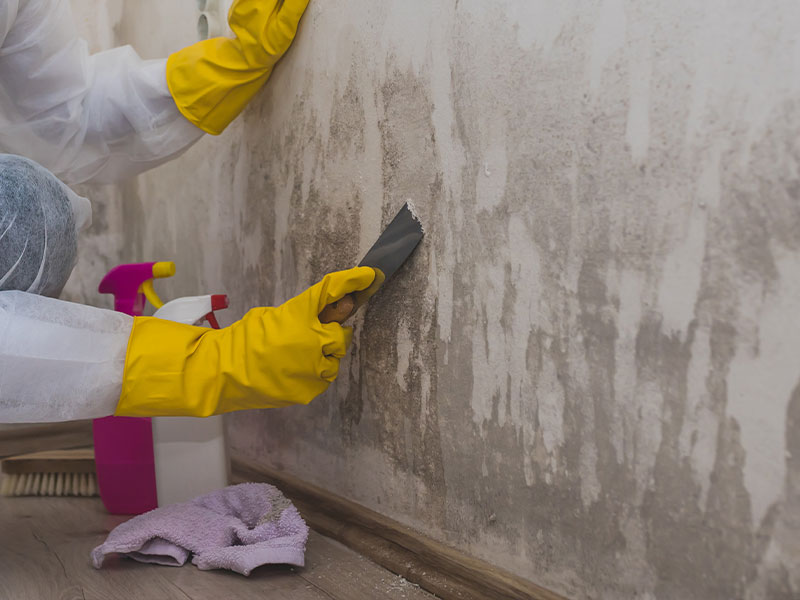
Fall does not automatically stop mold growth. In humid climates, mild weather can reduce AC runtime and therefore reduce the system’s incidental dehumidification. If moisture remains around coils, drain pans, ducts, insulation, crawl spaces, or other building materials, mold may continue growing even when the house feels comfortable.
That first cool fall morning in the Tidewater region can feel like a welcome break from summer heat. You turn the AC down, open the windows, and assume the season of indoor humidity problems is ending.
But your home may be telling a different story.
A musty odor when the HVAC system starts, condensation near a register, damp insulation, or unexplained discoloration around a vent can point to moisture that did not disappear with summer. In fact, fall can make some HVAC moisture problems easier to overlook because the air conditioner runs less often and therefore may remove less moisture from the indoor air.
If you suspect mold in an HVAC system, the goal is not simply to clean a vent cover. The important questions are where the moisture is coming from, which materials or HVAC components are affected, and whether professional mold remediation services are necessary.
Here is what Tidewater homeowners should know before a hidden moisture problem follows them into the heating season.
Table of Contents
Why Can Fall Make HVAC Mold Easier to Miss?
The problem is not simply “fall air.” It is the combination of moisture, temperature, HVAC runtime, and damp building materials.
During a hot Tidewater summer, an air conditioner may run frequently. As it cools the home, it also removes moisture from the air. When outdoor temperatures become milder, the system may cycle less frequently.
ASHRAE explains that conventional air conditioning provides dehumidification while cooling, but this moisture removal may be insufficient during mild weather when the AC runs less. EPA guidance likewise identifies condensation and high relative humidity as important indicators of potential mold growth in ductwork.
That creates a fall-season blind spot: the temperature indoors can feel comfortable while moisture remains elevated in hidden locations.
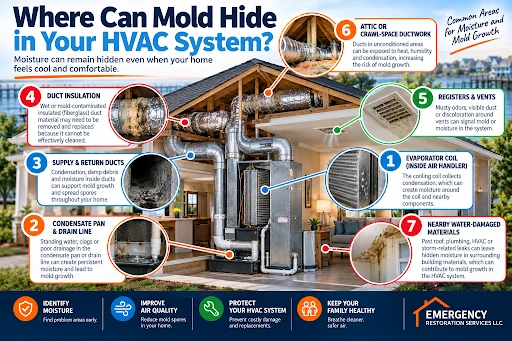
Those locations may include:
- Evaporator coils and condensate pans
- Supply and return ductwork
- Wet or damp duct insulation
- Air-handler cabinets
- Areas around registers
- Attics and crawl spaces surrounding ductwork
- Walls or ceilings affected by previous leaks or water damage
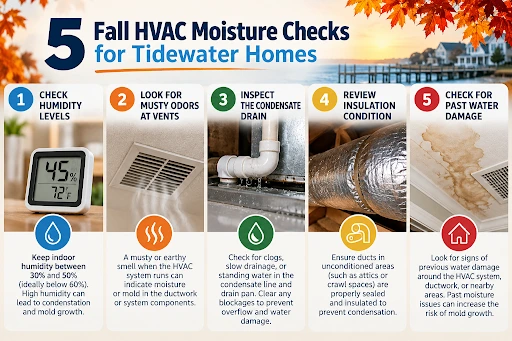
The EPA recommends keeping indoor relative humidity below 60%, ideally between 30% and 50% when possible.
For Tidewater homeowners, indoor humidity control therefore deserves attention even after the hottest part of the year is over.
What Causes Mold in an HVAC System?
Mold requires moisture to grow. CDC identifies excess moisture as the major cause of indoor mold growth, while EPA guidance emphasizes moisture control as the most effective way to prevent biological growth in air ducts.
An HVAC system can encounter moisture in several ways.
Condensation Around Cooling Components
Cooling coils naturally produce condensation as the system removes moisture from warm air. That water should drain properly.
A clogged drain line, poorly draining condensate pan, wet insulation, or another drainage problem can allow moisture to remain where it should not.
High Indoor Humidity
AC mold growth is not limited to homes with a major leak.
Humidity alone can contribute enough moisture for mold growth under the right conditions. That is why monitoring indoor humidity remains important during Tidewater’s seasonal transition.
Leaky or Poorly Insulated Ducts
Ducts routed through attics, crawl spaces, and other unconditioned spaces can face significant temperature and moisture differences. If ducts are inadequately sealed or insulated, humid air and cool surfaces may create condensation.
Previous Water Damage
A past plumbing leak, roof leak, storm event, overflowing drain pan, or other water problem may leave moisture in insulation, drywall, wood, or nearby HVAC materials.
This is why drying the visible water is only part of restoration. ERS’s guide to water damage restoration in Virginia Beach discusses the connection between water damage, moisture, drying, and mold prevention.
5 Signs Your HVAC System Deserves a Closer Look This Fall
Not every dark mark is mold, and not every odor coming from a vent proves there is mold inside the ductwork.
Still, these warning signs deserve attention.
| Warning Sign | What It May Indicate |
| Musty air vents | Moisture or microbial growth somewhere near the HVAC system or connected building materials |
| Dark or unusual discoloration around registers | Possible contamination, condensation, dirt, or another issue requiring evaluation |
| Water near the air handler or drain pan | Condensate drainage or moisture-control problem |
| Damp or wet duct insulation | Condensation, leakage, or moisture intrusion |
| Odor becomes stronger when HVAC starts | A possible issue associated with an HVAC component or air pathway |
A particularly useful clue is timing. If a musty odor consistently appears or becomes stronger when the HVAC fan starts, tell the professional evaluating the property. That pattern may help narrow down where the problem is located.
What Should a Tidewater HVAC Mold Evaluation Look For?
An effective evaluation should go beyond removing a register cover and shining a flashlight into the nearest duct.
The objective is to determine where moisture is entering or accumulating and what materials are actually affected.
Depending on the property and the suspected problem, an evaluation may consider:
1. Moisture Conditions
Are walls, ceilings, floors, cabinets, insulation, or other nearby materials holding excess moisture?
Emergency Restoration Services uses moisture meters and infrared thermal imaging as part of its mold inspection process to help identify the origin and extent of moisture-related damage.
2. HVAC Components
Areas such as cooling coils, condensate pans, accessible ductwork, filters, air handlers, and nearby insulation may need to be examined.
3. The Moisture Source
This is one of the most important parts of the investigation. Cleaning visible growth without correcting the condition that allowed it to develop can lead to recurrence.
4. Affected Materials
Bare sheet-metal ductwork and wet, internally insulated ductwork cannot always be handled the same way. That is one reason HVAC mold cleaning should not be treated as a one-size-fits-all service.
HVAC Mold Cleaning vs. Mold Remediation
Routine duct cleaning and mold remediation solve different problems.
Duct cleaning generally focuses on removing accumulated dust and debris. Professional mold remediation focuses on identifying affected materials, controlling contamination, removing or cleaning materials appropriately, and critically addressing the moisture conditions associated with the growth.
If mold affects areas beyond an easily cleaned register cover, simply wiping the vent or spraying a product into the duct is not a complete moisture-control strategy.
For confirmed or suspected contamination involving multiple building materials, ERS provides professional Mold removal and remediation services for homes and businesses throughout Virginia Beach and surrounding Tidewater communities.
When Should You Call a Mold Removal Company?
Professional evaluation is worth considering when:
- Musty odors repeatedly come from vents
- Visible growth appears around multiple registers
- Growth returns after surface cleaning
- You discover wet or moldy duct insulation
- Water has entered or collected near the HVAC system
- A leak, flood, or storm has affected walls, ceilings, crawl spaces, or ductwork
- You suspect contamination inside inaccessible HVAC components
- Mold appears to involve more than a small, isolated surface
The HVAC system deserves particular caution because it moves air throughout the property. EPA states that an HVAC system associated with an identified moisture problem may itself become a site of mold growth and that known or suspected growth in HVAC components should be investigated and resolved promptly.
If extensive contamination is discovered, emergency mold remediation may also be appropriate when delaying action could allow moisture damage or contamination to spread.
How Can Tidewater Homeowners Reduce Fall HVAC Mold Risk?
Prevention starts with controlling moisture rather than trying to eliminate every mold spore. CDC notes that mold exists indoors and outdoors and recommends keeping household humidity no higher than 50% when possible.
A few practical habits can make hidden moisture easier to catch:
- Monitor indoor humidity. A basic hygrometer can reveal humidity problems that temperature alone will not show.
- Check the condensate area. Standing water near an air handler or drain pan deserves investigation.
- Pay attention to odors. Note whether a musty smell occurs all day or specifically when the HVAC system runs.
- Inspect visible vents and registers. Look for recurring condensation, staining, or unexplained discoloration without disturbing suspected growth.
- Check moisture-prone spaces. Crawl spaces and attics can influence ducts running through them.
- Address leaks quickly. Roof, plumbing, drainage, and HVAC leaks should not be allowed to keep building materials damp.
- Do not assume a clean vent cover means a clean system. The source may be deeper in the air handler, duct insulation, drain assembly, or surrounding building materials.
Quick Fall HVAC Moisture Check
Before switching fully from cooling to heating, ask yourself:
Do I smell anything musty when the system starts? Is there condensation around vents? Is the condensate pan draining? Has the home had a leak or water incident this year? Does indoor humidity stay elevated even when the house feels cool?
A “yes” does not automatically mean you have mold. It does mean the moisture source deserves attention.
Key Takeaways
- Cooler fall weather does not automatically eliminate indoor mold risk.
- During mild weather, reduced AC runtime can also mean less incidental dehumidification.
- Musty air vents are a warning sign worth investigating, but odor alone does not prove mold is inside the ductwork.
- Condensate pans, cooling coils, duct insulation, air handlers, crawl spaces, and previous water-damaged materials are important areas to evaluate.
- EPA recommends keeping indoor relative humidity below 60%, ideally between 30% and 50% when possible.
- Indoor humidity control and correction of the underlying moisture source are essential because mold can return when the conditions that supported it remain.
- HVAC duct cleaning and professional mold remediation are not automatically the same service.
- Wet or mold-contaminated porous duct materials may require replacement rather than simple cleaning.
Do Not Let Comfortable Fall Air Hide a Moisture Problem
Fall in Tidewater can be deceptive. Your home may feel cooler and more comfortable while moisture remains hidden around an HVAC system, inside insulation, or in nearby building materials.
That is why a recurring musty smell should not simply be covered with an air freshener, and visible staining around a vent should not automatically be treated as a duct-cleaning problem.
The better approach is to find out where the moisture is coming from, what is affected, and what needs to change so the problem does not return.
Emergency Restoration Services LLC serves Virginia Beach and surrounding Tidewater communities with professional mold inspection and remediation services. ERS uses moisture-detection equipment, infrared thermal imaging, containment, HEPA filtration, drying equipment, and material-specific remediation methods as part of its established mold-remediation process.
Concerned About Mold or Musty HVAC Air?
If you see suspected mold, find unexplained moisture, or notice a persistent musty odor when your HVAC system runs, contact Emergency Restoration Services LLC for an evaluation.
Call for 24/7 assistance or learn more about ERS’s professional Mold removal and remediation services in Virginia Beach and the surrounding Tidewater area.
Frequently Asked Questions
1. Can mold in an HVAC system spread to other rooms?
Air movement may carry mold spores or particles from affected areas to other parts of a home, making it important to investigate suspected contamination.
2. Should I run my HVAC system if I suspect mold inside it?
If significant mold growth is suspected within HVAC components, consider having the system professionally evaluated before continued operation.
3. Can a new HVAC system still develop mold problems?
Yes. Even newer systems can experience mold-related issues if condensation, drainage problems, installation defects, or other moisture sources are present.
4. Does homeowners insurance cover HVAC-related mold remediation?
Coverage varies by policy and the cause of the moisture. Mold resulting from a covered sudden water-loss event may be treated differently from mold caused by long-term humidity or maintenance issues.